The lost library of Nalanda: Treasure of knowledge reduced to ashes
By | Education | 05-Dec-2025 12:17:10
News Story
More than a thousand years before
modern universities shaped global education, India stood as the cradle of
unparalleled scholarship at Nalanda Mahavihara in present-day Bihar.
At the heart of this ancient
academic powerhouse was Dharmaganja — known as the “Treasury of Knowledge” — a
sprawling library complex that housed an extraordinary wealth of manuscripts
and attracted scholars from across Asia.
Far beyond a single hall or monastic
bookroom, Dharmaganja was a multi-structured hub comprising three grand library
buildings — Ratnasagara, Ratnodadhi, and Ratnaranjaka — each dedicated to
specialized fields and scholarly pursuits.
Thousands of resident students and
teachers accessed manuscripts spanning logic, grammar, medicine (both Ayurvedic
and Buddhist), astronomy, mathematics, literature, linguistics, and global
Buddhist philosophy.
Chinese monk Xuanzang, who studied
at Nalanda in the 7th century CE, chronicled the library’s impressive scale and
the rigorous intellectual atmosphere. His vivid accounts, later translated by
Victorian scholar Samuel Beal, describe vast storehouses of manuscripts and
dynamic scholarly debate that made Nalanda a beacon of knowledge.
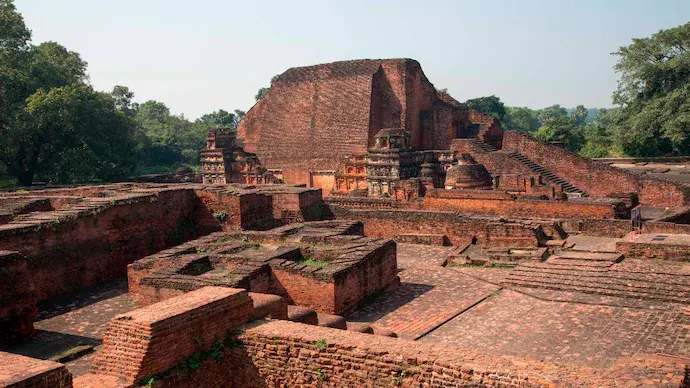
Archaeological excavations by the
Archaeological Survey of India (ASI) confirm the site’s grandeur: massive
monasteries, lecture halls, and extensive storage rooms believed to be part of
this legendary library complex.
While folklore sometimes inflates
the scale, historical records and UNESCO’s World Heritage dossier affirm
Dharmaganja’s status as one of Asia’s largest and most influential centers of
learning.
The library’s catastrophic
destruction in the late 12th century, referenced in Persian chronicles and
modern histories, stands as one of humanity’s most devastating intellectual
losses.
Manuscripts were burned, knowledge
erased, and a flourishing academic tradition abruptly silenced. Yet, the spirit
of Nalanda endures—in manuscripts carried by scholars to distant lands, in the
ruins that whisper stories of a golden era, and in the world’s continued
reverence for India’s ancient scholarly legacy.
Nalanda’s lost library is not just a
tale of destruction but a powerful reminder of the enduring value of knowledge
and the irreversible cost when it is lost to time and turmoil.