UP madrassa students left in academic limbo pivot to universities after Kamil–Fazil recognition collapse
By | Education | 08-Dec-2025 19:33:31
News Story
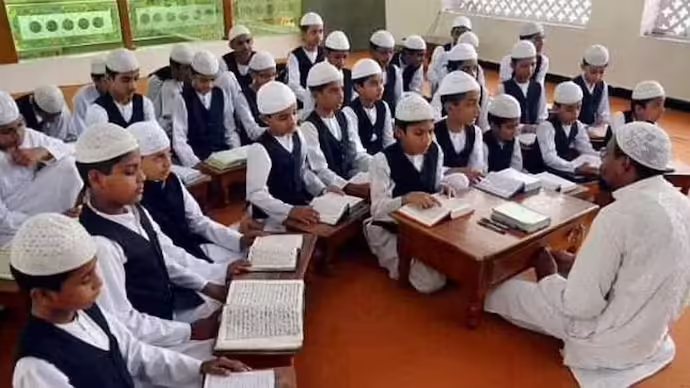
The future of thousands of madrassa students in Uttar Pradesh has entered a phase of disruption and redirection after the Supreme Court struck down the state madrassa board’s authority to award Kamil and Fazil degrees under the University Grants Commission (UGC) Act.
The ruling — delivered on November 5
last year — declared the degrees unconstitutional and reserved certification
powers exclusively for universities, leaving an estimated 32,000 students in
academic limbo.
For many, the verdict means recalibration, compromise, and in some cases, starting over.
A traditional academic ladder now paused
Madrassa education follows a structured system
beginning with Munshi and Maulvi courses — considered equivalents to Class 10
and Class 12 — and progressing to Kamil and Fazil, treated at par with
undergraduate and postgraduate levels in Islamic theology and Arabic studies.
While these qualifications have historically held value within religious institutions, students seeking mainstream academic or professional tracks often transition into conventional BA and MA programmes. With recognition revoked, that pathway has now shifted from optional to necessary.
Students caught midstream, futures on hold
For many learners, the ruling wasn't just
legal — it was personal.
“I have to think about my career,” said
Saqlain Raza, a Fazil first-year student from Varanasi’s Jamia Farooquia, who
now plans to pursue a BA and later an MA. Although his Aalim certificate
qualifies him for university, the time already invested in Kamil and Fazil may
not count.
Ghulam Masih, a Kamil first-year student from
Siddharthnagar, echoed similar concerns. He hopes that an ongoing petition
seeking affiliation with Khwaja Moinuddin Chishti Language University will
provide a lifeline.
For others, the consequences are more severe.
Mau district student Mohammad Saad Nizami said his academic journey has stalled
after his February 2024 exam.
“It feels like I’ve lost one-and-a-half years,” he said, adding that without a solution soon, he may be forced to abandon his studies altogether.
Govt reassurances, legal uncertainty
The state government has attempted to steady
nerves. Minister of State for Minority Welfare Danish Azad Ansari has assured
that teachers employed in aided madrassas on the basis of Kamil and Fazil
qualifications will not face job insecurity.
Meanwhile, the Teachers’ Association Madaris-e-Arabia Uttar Pradesh has approached the Supreme Court seeking affiliation of students with the Khwaja Moinuddin Chishti Language University to validate exams, semesters, and academic credits already completed. The Court has asked for responses from the state government, the UGC, and the madrassa education board, with the matter still pending.
Concerns over academic equivalence and accessibility
Not everyone supports the push for mid-course
affiliation. BJP Minority Morcha leader Kunwar Basit Ali argued that the
madrassa syllabus does not match university standards and recommended fresh
admissions instead of lateral entry.
For madrassa leadership and teachers, such
proposals represent not just an academic hurdle, but a socioeconomic one.
“Most of these students come from economically
weaker backgrounds,” said Diwan Sahab Zaman Khan, general secretary of the
madrassa teachers’ association. “If they are forced to restart their degrees
privately, many will simply not be able to afford it.”
A senior official from Khwaja Moinuddin Chishti Language University declined to comment, saying the issue remains sub judice.
As the debate continues — balancing legal compliance, academic standards, and student futures — one reality is already clear: for thousands of young learners in Uttar Pradesh, this ruling has reshaped education from a path to progress into a race against time.